Holle Cow Formula Stage PRE (400g)
Price range: $25.99 through $439.80Select options
This product has multiple variants. The options may be chosen on the product page
Welcome 🤍 10% OFF with FIRSTORDER + 5% loyalty code in your first box
Welcome 🤍 10% OFF with FIRSTORDER + 5% loyalty code in your first box

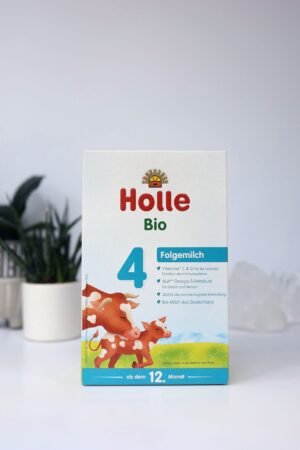
Holle Cow Milk Formula represents over 85 years of Swiss and German organic farming expertise distilled into one of the world’s most trusted infant nutrition lines. Produced in Germany and Switzerland under Demeter biodynamic certification — the gold standard of organic farming, a full tier above standard EU organic — Holle Cow formula sets a benchmark that virtually no other formula brand can match for ingredient purity, ethical sourcing, and nutritional integrity.
Holle’s cow milk formula is made from whole organic cow’s milk sourced exclusively from Demeter-certified biodynamic farms, where cows graze freely on pesticide-free pastures, are never treated with synthetic hormones or routine antibiotics, and live in conditions that prioritize animal welfare as fundamentally as they prioritize milk quality. The result is a richer, more nutritionally complete base milk — and a formula that parents around the world trust as the closest they can get to nature.
With over 1,400 combined verified reviews averaging above 4.91/5 across all five stages, Holle Cow is not just a formula — it is a proven, parent-validated feeding solution for every stage of your baby’s first years of life.
Rated an exceptional 4.96/5 across 376 verified reviews, Holle Stage Pre is the purest entry point in the Holle Cow range. Designed for newborns from birth as a breastfeeding supplement or sole nutrition source, Stage Pre uses lactose as its only carbohydrate — no starch, no maltodextrin, no fillers. This makes it the most breast-milk-like option in the Holle lineup, gentle enough for the most sensitive newborn digestive systems. It contains organic skimmed milk, organic vegetable oils (palm, rapeseed, sunflower), and essential vitamins and minerals to support healthy development from day one.
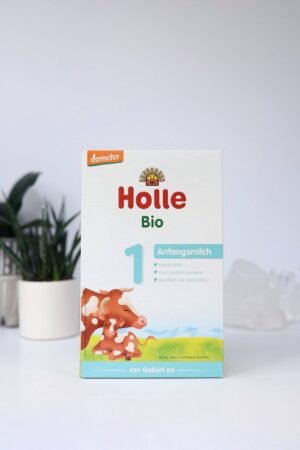
The most reviewed product in the entire Holle range — 4.92/5 across 429 verified reviews. Stage 1 is suitable from birth and can be used as a complete breast milk substitute or supplement. It differs from Stage Pre with the addition of a small amount of organic starch, which makes feeds slightly more satiating — particularly useful for hungrier babies. Built on the same Demeter-certified biodynamic milk base, Stage 1 delivers comprehensive nutrition including DHA for brain development, essential fatty acids, and the full vitamin and mineral profile required for healthy infant growth.
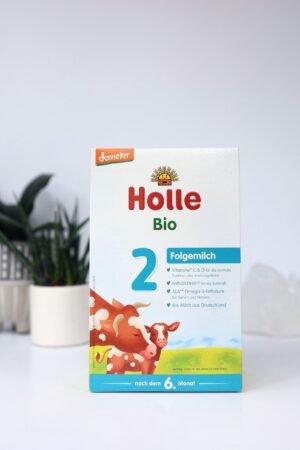
Rated 4.93/5 across 353 reviews, Holle Stage 2 is formulated for babies from 6 months as they begin their weaning journey. As solid foods are introduced, Stage 2 complements a growing diet by maintaining full nutritional coverage while adjusting the formula’s composition to meet the evolving needs of an older baby. The organic starch content provides slightly increased satiety to match growing appetites, and the Demeter-certified milk base continues to deliver superior quality compared to conventionally farmed alternatives.
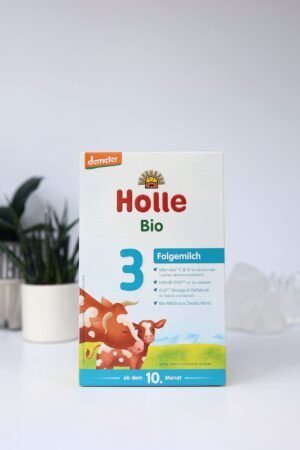
Trusted by parents with a 4.92/5 rating across 181 reviews, Holle Stage 3 bridges the gap between formula dependence and a fully varied toddler diet. From 10 months, babies become increasingly mobile, curious, and energetically demanding — and Stage 3 adjusts to meet that energy output with an optimized nutrient profile. It continues to provide essential DHA, iron, calcium, and vitamins critical during a phase of rapid physical and cognitive development.
Rated 4.91/5 across 94 reviews, Holle Stage 4 is a growing-up milk designed for toddlers from 12 months. As your child’s diet becomes increasingly food-based, Stage 4 acts as a reliable nutritional safety net — filling the gaps that even the best toddler diet can leave. Rich in calcium for bone development, iron for cognitive function, and essential fatty acids for continued brain maturation, Stage 4 is the ideal complement to an active, food-curious toddler’s lifestyle.
The single biggest differentiator Holle brings to the table is Demeter biodynamic certification. While most “organic” formulas meet the baseline EU organic standard — which prohibits synthetic pesticides and GMOs — Demeter certification goes dramatically further. Demeter farms operate as self-sustaining ecosystems, following strict biodynamic farming principles that govern everything from soil health and crop rotation to animal welfare and lunar planting cycles. The result is milk of measurably superior quality: higher in beneficial fatty acids, richer in natural nutrients, and completely free from the residual inputs that even some organic operations still permit.
Holle also maintains extraordinary transparency in its supply chain. Every cow that contributes milk to Holle formula is traceable, every farm is audited, and every production batch is tested against HiPP-comparable internal quality standards. For parents who want to know exactly what they are feeding their child — and where it came from — Holle is the answer.
The formula itself is deliberately simple: short ingredient lists, recognizable components, and nothing that doesn’t serve a clear nutritional purpose. In an industry full of proprietary blends and marketing-driven complexity, Holle’s commitment to simplicity and transparency is a profound competitive advantage — and the reason parents return to it again and again across multiple children.
Both are suitable from birth, but the key difference is carbohydrate composition. Stage Pre contains only lactose as its carbohydrate — the purest, most breast-milk-like option, ideal for sensitive newborns or parents who want the absolute simplest formula. Stage 1 adds a small amount of organic starch, which makes feeds slightly more filling and may suit hungrier babies who seem unsatisfied on Stage Pre alone. If your baby is doing well on either, there is no nutritional reason to switch.
Demeter is the world’s oldest and most rigorous organic certification, founded in 1928. It exceeds standard EU organic requirements significantly. Demeter farms operate as closed-loop ecosystems — soil health, animal welfare, biodiversity, and farming practices are all governed by strict biodynamic standards. For infant formula, this means the source milk comes from cows living in genuinely natural conditions, producing milk with superior fatty acid profiles and nutritional density compared to both conventional and standard-organic alternatives.
Yes. All stages of Holle Cow formula meet EU infant formula regulations and are formulated to serve as a complete nutritional source for babies when breastfeeding is not possible or not chosen. Stages Pre and 1 can be used as the sole source of nutrition from birth. From Stage 2 onward, formula complements the introduction of solid foods rather than replacing them entirely.
Yes. All stages of Holle Cow formula contain DHA (docosahexaenoic acid), an omega-3 fatty acid essential for brain development and visual function in infants. Holle sources its DHA from sustainable fish oil, in compliance with EU infant formula regulations governing DHA content and sourcing.
Yes, Holle Cow formula contains organic palm oil as part of its vegetable oil blend, alongside rapeseed and sunflower oil. The palm oil provides palmitic acid, a fatty acid naturally abundant in breast milk. Holle sources its palm oil from certified sustainable, organic suppliers. While some parents prefer palm-oil-free formulas (Holle’s Goat formula is palm-oil-free), the organic palm oil in Holle Cow is considered safe and nutritionally appropriate by European regulatory authorities.
Stage transitions are guided by age milestones — Pre/Stage 1 from birth, Stage 2 from 6 months, Stage 3 from 10 months, Stage 4 from 12 months. However, these are guidelines rather than hard deadlines. If your baby is thriving on their current stage, there is no urgent need to switch exactly at the milestone age. Transition when your baby’s hunger cues or developmental progress suggest they need the next stage’s nutritional profile.
No. Holle Cow formula is based on whole cow’s milk and is not suitable for babies with confirmed cow’s milk protein allergy (CMPA). For CMPA, an extensively hydrolyzed or amino acid-based formula prescribed by a physician is required. If you suspect your baby has CMPA — symptoms include persistent rashes, blood in stool, severe digestive upset, or respiratory symptoms — consult your pediatrician immediately before switching formulas.
Both are premium European organic formulas and among the best available globally. The key differences: Holle holds Demeter biodynamic certification (a higher standard than EU organic), while HiPP Combiotic includes probiotics and prebiotics (Holle does not). Holle’s ingredient list is simpler and shorter; HiPP offers more functional additions for gut health. Parents choosing Holle tend to prioritize ingredient purity and farming standards; parents choosing HiPP often value the Combiotic gut support. Both are excellent choices — the right one depends on your baby’s specific needs.
Yes, switching between premium European organic formulas is generally well-tolerated. A gradual transition over 3–5 days — mixing increasing proportions of the new formula with the current one — is recommended to allow your baby’s digestive system to adjust. Some babies transition immediately without issue; others may take a week or two to fully adapt. Monitor for any changes in stool consistency, gas, or comfort during the transition.
Always prepare Holle formula with freshly boiled water cooled to approximately 40–50°C. Add the correct number of scoops as specified on the packaging — never add extra powder to make feeds more concentrated. Store unopened tins in a cool, dry place away from direct sunlight. Once opened, seal tightly and use within 3 weeks. Prepared formula should be consumed within 2 hours and any leftovers discarded — never reheat or reuse prepared formula.